
By J. Chadwick Schnee January 1, 2026
The Importance of Transparency in Municipal Law
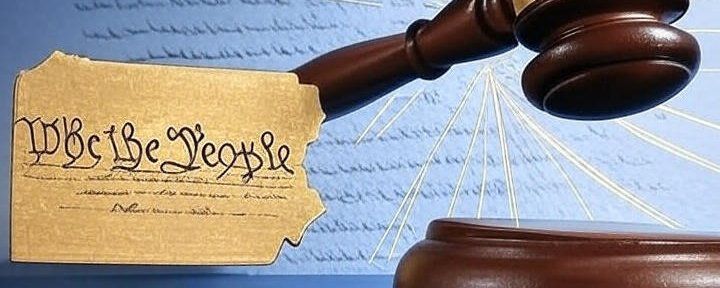
A judge 's gavel is sitting on top of a piece of paper that says we the people.
By J. Chadwick Schnee August 1, 2025
PA's Anti-SLAPP Shield: How We Won $6K+ for a Client's Free Speech Rights
By J. Chadwick Schnee June 15, 2025
Supreme Court Rejects "Background Circumstances" Rule in Title VII Cases: What It Means for You
By J. Chadwick Schnee May 15, 2025
Breaking Down the Commonwealth Court’s Ruling on RTK Law: A Closer Look at Shepherd v. Pennsylvania Office of the Governor
April 15, 2025
Agencies beware: Injunctive relief against users of the Right-to-Know Law may be increasingly difficult under Pennsylvania’s Anti-SLAPP Statute
By J. Chadwick Schnee, Esq March 15, 2025
The Importance of Procedural Due Process: A Successful Expungement of a Mental Health Commitment in Erie County, PA
A scale of justice sits on a wooden podium in a courtroom
By J. Chadwick Schnee, Esq January 15, 2025
As a matter of first impression, a Commonwealth Court judge has ruled that post-trial motions under Pa. R.Civ.P. 227.1 are not required in an appeal from an order in a Right-to-Know Law enforcement action. In Walker v. County of Bucks, a requester filed an enforcement action against an agency and its open-records officer where the agency had filed two appeals of the same OOR final order (rather than two appeals of two different OOR final orders), arguing that relief in mandamus was appropriate because one of the two OOR final orders was not appealed.[1] The trial court rejected the complaint, holding that relief in mandamus “is not clear at this time” due to a pending motion to substitute one its appeals.[2] The requester appealed but did not file post-trial motions. The agency argued that, under Pa.R.Civ.P. 227.1, the requester “waived all issues on appeal and her appeal must be dismissed” because she did not file post-trial motions. Commonwealth Court Judge Dumas disagreed, holding that a RTKL enforcement action “is not a situation where post-trial motions had to be filed” because the complaint in mandamus was covered by “‘petition practice’” as set forth under the Note to Pa R.A.P. 3761.[3] Instead, “it is evident that the mandamus action filed by Appellant was in petition practice, such that post-trial motions were not necessary.”[4] While this is an unreported memorandum opinion of a single member of the Commonwealth Court, parties to a RTKL enforcement action potentially may not be required to file post-trial motions in order to preserve issues on appeal. (This post should not be considered legal advice. For more information or to discuss, Attorney Schnee can be reached at chadwick@schneelegal.com ). [1] Walker v. County of Bucks, 974 C.D. 2023 (Pa.Cmwlth. Jan. 31, 2024) (Dumas, J.) (unreported). The author represents the requester in this matter. [2] Id. [3]The Note provides Pa.R.A.P. 3761(b) provides the method for seeking compliance with a final determination of the Office of Open Records in the Commonwealth Court. This differs from proceeding in the courts of common pleas, where the method to obtain judicial review of alleged failure to comply with a final determination of the Office of Open Records may be an action in mandamus or other petition authorized by local rule. Capinski v. Upper Pottsgrove Township, 164 A.3d 601 (Pa. Cmwlth. 2017). Use of this petition is appropriate when the final determination was not appealed. If an appeal was taken and the order affirmed by the Commonwealth Court, enforcement is not of the final determination of the Office of Open Records, but rather of the order of the Commonwealth Court. [4] Walker v. County of Bucks, 974 C.D. 2023 (Pa.Cmwlth. Jan. 31, 2024) (Dumas, J.) (unreported).
A blurry picture of a city street with taxis driving down it.
By J. Chadwick Schnee, Esq. December 15, 2024
The Pennsylvania Commonwealth issued a ruling on November 8, 2023 holding that an agency violated open meeting laws when it added the consideration of a collective bargaining agreement with its teachers union without first providing public notice. The case, brought by now-Senator Jarrett Coleman, alleged that the Parkland School District violated the Sunshine Act when it voted to approve a multi-year collective bargaining agreement with its teachers union when that item was not previously listed as part of a public agenda. In other words, the public had no prior notice that the collective bargaining agreement would be considered unless they happened to attend the public meeting. The case concerned 2021 amendments to the Sunshine Act that, until now, had never previously been interpreted by an appellate court. Specifically, this section, Section 712.1, provides as follows: (a) Official action.--Except as provided in subsection (b), (c), (d) or (e), an agency may not take official action on a matter of agency
A pen is sitting on top of a notebook next to a cell phone.
By J. Chadwick Schnee, Esq. November 15, 2024
Employment discrimination is a serious issue that affects many workers in Pennsylvania. If you believe you have been discriminated against in the workplace, you may be entitled to file a claim. The process of bringing an employment discrimination claim in Pennsylvania can be complex, but with the right information and guidance, you can navigate it successfully. In this blog post, we will discuss the steps involved in bringing an employment discrimination claim in Pennsylvania. Step 1: Understand the Different Types of Employment Discrimination Before you can bring a claim for employment discrimination, it is important to understand what constitutes discrimination in the workplace. Under Pennsylvania law, it is illegal for employers to discriminate against employees on the basis of their race, color, national origin, sex, religion, disability, age (40 years and older), or genetic information. Discrimination can take many forms, including: Refusing to hire, promote, or train an employee because of their protected status. Paying an employee less than other employees doing similar work because of their protected status. Firing or laying off an employee because of their protected status. Harassing an employee because of their protected status. Failing to provide reasonable accommodations to an employee with a disability. If you have experienced any of these forms of discrimination in the workplace, you may have grounds for a claim. Step 2: File a Charge with the Pennsylvania Human Relations Commission or the Equal Employment Opportunity Commission Before you can file a lawsuit for employment discrimination in Pennsylvania, you must first file a charge with either the Pennsylvania Human Relations Commission (PHRC) or the Equal Employment Opportunity Commission (EEOC). The PHRC is a state agency that handles discrimination claims in Pennsylvania, while the EEOC is a federal agency that handles claims under federal law. To file a charge with either agency, you must complete a form that provides details about the discrimination you experienced, including when it occurred, who was involved, and how it affected you. You must file your charge within 180 days of the discriminatory act, or within 300 days if the discrimination occurred in a place with its own state or local anti-discrimination law. Once your charge is filed, the agency will investigate the matter and may attempt to mediate a settlement between you and your employer. Step 3: Consider Mediation In some cases, the PHRC or the EEOC may offer mediation as an option for resolving your discrimination claim. Mediation is a process in which a neutral third party works with you and your employer to try to reach a mutually acceptable resolution. Mediation can be a faster and less expensive way to resolve your claim than going to court, but it is not always successful. Step 4: File a Lawsuit If mediation is unsuccessful, or if you choose not to pursue it, you may file a lawsuit against your employer. To file a lawsuit for employment discrimination in Pennsylvania, you must first obtain a right-to-sue letter from the PHRC or the EEOC. This letter gives you permission to file a lawsuit in court. In your lawsuit, you must prove that your employer engaged in discriminatory behavior and that this behavior harmed you in some way, such as by causing you to lose your job or suffer emotional distress. You may also be entitled to damages, such as lost wages, emotional distress, and punitive damages. Step 5: Seek Legal Representation Bringing an employment discrimination claim in Pennsylvania can be a complicated and time-consuming process. To give yourself the best chance of success, it is important to seek the assistance of an experienced employment discrimination attorney. An attorney like J. Chadwick Schnee, Esq. can help you navigate the legal system, gather evidence, and present your case in the most effective way possible. In conclusion, if you have experienced employment discrimination in Pennsylvania, you have legal rights and options. If you need to find a discrimination lawyer near you, Contact attorney Schnee at 717.400.5955 or chadwick@schneelegal.com to learn more.

Are public libraries subject to the Right-to-Know Law? Definitely maybe.

J. Chadwick Schnee, Esq

Are public libraries subject to the Right-to-Know Law? Definitely maybe.

The Pennsylvania Right-to-Know Law (“RTKL”) is a powerful tool that provides citizens with the right of access to public records. It is designed to promote transparency and accountability in government. However, the application of this law to various entities, including public libraries, can sometimes be complex and nuanced. This blog post aims to analyze whether public libraries may be subject to the Pennsylvania RTKL in light of the case Pysher v. Clinton Township Volunteer Fire Co., 299 A.3d 196 (Pa. Commw. 2023).


The Pennsylvania Right-to-Know Law


The RTKL affords the public with access to records of state and local governments, providing Pennsylvanians with the right to request and receive records showing precisely what the government is doing. The law contains strict deadlines for responses and numerous exemptions. All “records” (as defined by the RTKL) within Pennsylvania are presumptively subject to public access.


One of the threshold questions, however, is what constitutes a local agency?


Volunteer fire companies may be subject to the disclosure requirements of the RTKL - Pysher v. Clinton Township Volunteer Fire Co.


In case of Pysher v. Clinton Township Volunteer Fire Co., the Court of Common Pleas of Lycoming County affirmed a Final Determination of the Office of Open Records (“OOR”) and ordered the Clinton Township Volunteer Fire Company to turn over documents responsive to a RTKL request made by a requester. The key issue was whether the Fire Company was a “local agency” subject to the RTKL. The court found that the Fire Company was indeed a local agency23. However, on appeal to the Commonwealth Court, the Commonwealth Court found the record lacked facts necessary for a meaningful review of the nature of the relationship between the Fire Company and Clinton Township and remanded the case for further development of the factual record.


Following the remand, the trial court engaged in further factfinding and found that the Fire Company was a local agency, and, on appeal, the Commonwealth Court agreed. Specifically, the Commonwealth Court found that “the nature of the Fire Company’s functions” was a “‘strong factor in favor of finding that’” the Fire Company is a local agency because providing fire and emergency services is an essential function of government.


The Court also looked the level of government control over the Fire Company, and found that, while a municipality did not exercise “active control” over the Fire Company, the ability to “exercise passive or political control and oversight over” the Fire Company weighed in favor of finding the Fire Company to be a local agency.


Finally, the Court found that, because more than 50% of the Fire Company’s funding comes from public sources and that one municipality had exercised its authority to audit the Fire Company in the past. As a result, the Court found that this factor also weighed in favor of finding the Fire Company is an agency subject to the open records requirements of the Right-to-Know Law.


Implications for Public Libraries


While the Pysher case is unreported – meaning that it is not controlling on any court outside of the parties in that case – it is still considered “persuasive,” meaning that it could be used to influence cases involving other agencies, such as public libraries.


If a public library is considered a “local agency” under the RTKL, it would be subject to the law’s provisions. This would mean that the public could request and receive records from the library, subject to certain exemptions.

However, whether a public library qualifies as a “local agency” may depend on the specific facts and circumstances, including the nature of the relationship between the library and the local government. As the Pysher case demonstrates, this can be a complex and fact-intensive inquiry that looks to (1) the nature of the entity’s functions; (2) the degree of governmental control; and (3) the degree of financial control.


In conclusion, while the Pysher case does not directly address the issue of public libraries and the RTKL, it provides valuable insights into how courts may approach the question. It underscores the importance of a detailed factual analysis in determining whether an entity like a public library is subject to the RTKL. As always, specific legal questions should be addressed with the assistance of legal counsel, including the attorneys at Schnee Legal Services, LLC.


This blog post is intended for informational purposes only and does not constitute legal advice. Always consult with a qualified attorney for legal advice.


By J. Chadwick Schnee January 1, 2026
The Importance of Transparency in Municipal Law
A judge 's gavel is sitting on top of a piece of paper that says we the people.
By J. Chadwick Schnee August 1, 2025
PA's Anti-SLAPP Shield: How We Won $6K+ for a Client's Free Speech Rights
Show More